
Choosing the right grout can make a big difference to the appearance, durability and maintenance of tiled surfaces. Two common options are epoxy grout and cement grout.
While both are used to fill the joints between tiles, they have different properties. Epoxy grout is known for its strong resistance to water, stains and chemicals, while cement grout is widely used because it is affordable and easier to apply.
So, which one should you choose?
The answer depends on where the grout will be used, how much moisture and traffic the area receives, your maintenance requirements and your budget.
In this guide, we explain the difference between epoxy grout and cement grout and help you understand where each option may be suitable.
What Is Cement Grout?
Cement grout is a traditional tile grout made primarily from cement, fine aggregates and other additives. It is mixed with water before application and is commonly used for residential and commercial tiling projects.
Cement grout is available in different colours and can be used for both floor and wall tiles.
How Does Cement Grout Work?
Cement grout is applied into the gaps between tiles. Once applied, it cures and forms a solid joint that helps keep tiles properly supported and prevents dirt from collecting in the open spaces.
Depending on the product and application, cement grout may require sealing to improve its resistance to moisture and staining.
Where Is Cement Grout Commonly Used?
Cement grout can be used for many general tiling applications, including:
- Bathroom walls and floors
- Kitchen walls and floors
- Living areas
- Bedrooms
- Residential floors
- Commercial areas
- Wall tiles
It is often selected when keeping the initial project cost lower is an important consideration.
What Is Epoxy Grout?

Epoxy grout is a two-component grout made using epoxy resin and a hardener, along with specially selected fillers and pigments.
Unlike traditional cement grout, epoxy grout does not rely on cement as its main binder. Once the components are mixed and cured, the grout forms a dense and durable joint.
Epoxy grout is commonly considered for areas exposed to moisture, stains, frequent cleaning or heavy use.
How Does Epoxy Grout Work?
Epoxy grout is mixed according to the manufacturer’s requirements and carefully applied into the tile joints.
It cures to create a strong grout joint with low water absorption. Proper surface preparation and application are important because epoxy grout can be less forgiving to work with than traditional cement grout.
Where Is Epoxy Grout Commonly Used?
Epoxy grout can be suitable for:
- Bathrooms
- Shower areas
- Kitchens
- Wet areas
- Commercial kitchens
- Restaurants
- Retail spaces
- High-traffic areas
- Commercial floors and walls
Epoxy Grout vs Cement Grout: Key Differences
Although both products perform the basic function of filling tile joints, their performance can differ considerably.
Water Resistance
One of the main differences is moisture resistance.
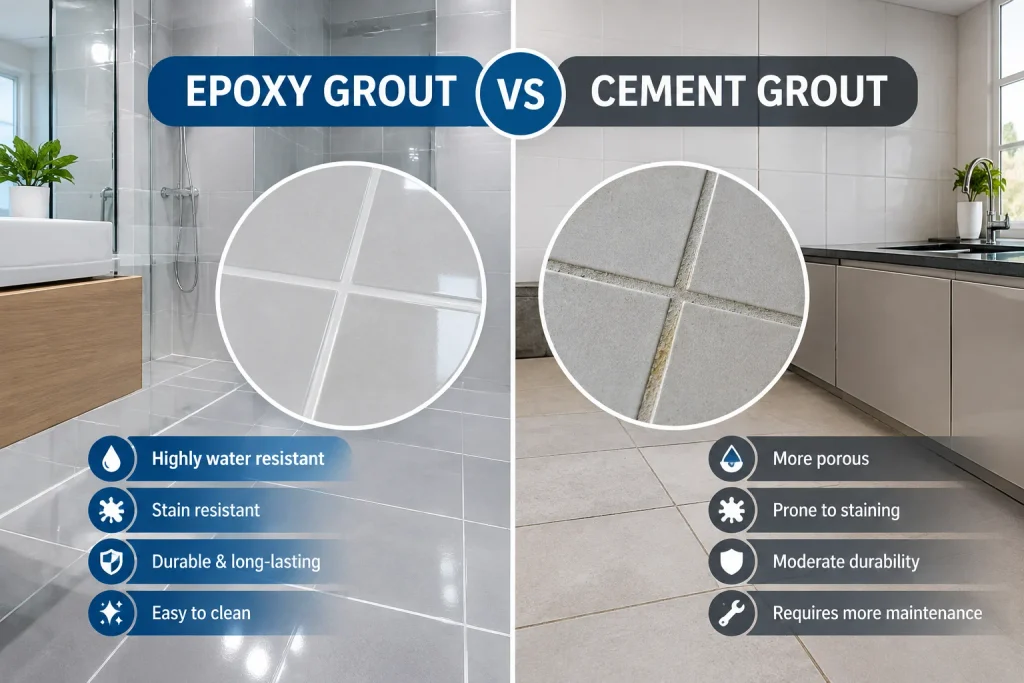
Epoxy grout has very low water absorption, making it suitable for areas that regularly come into contact with water.
Cement grout is more porous. Depending on the product, it may absorb moisture and may benefit from a suitable sealer, particularly in areas with regular water exposure.
For wet environments, epoxy grout can therefore be an option worth considering.
Stain Resistance
Epoxy grout generally offers better resistance to stains than standard cement grout.
This can be useful in kitchens, restaurants and other areas where the grout may come into contact with food, grease, dirt or coloured liquids.
Cement grout can become stained over time if it is not properly maintained or sealed.
Durability
Epoxy grout forms a hard, durable joint after curing. It can withstand regular cleaning and heavy use when correctly installed.
Cement grout can also provide good service, but it may be more susceptible to wear, staining and moisture-related deterioration depending on the environment and maintenance.
The actual lifespan of either grout depends on product quality, installation, tile movement, cleaning methods and the conditions of the area.
Cleaning and Maintenance
Epoxy grout is relatively easy to clean because its dense surface is less likely to absorb spills and dirt.
Cement grout can require more regular maintenance. Dirt can become embedded in its more porous surface, and some applications may require periodic sealing.
For properties where easy cleaning is a priority, epoxy grout may be more suitable.
Mould and Mildew Resistance
Moisture can contribute to mould and mildew growth around tiled areas.
Because epoxy grout absorbs very little water, it can help reduce the conditions that contribute to staining and moisture absorption within the grout itself.
However, grout alone cannot prevent mould throughout a bathroom or other wet area. Proper ventilation, cleaning, waterproofing and moisture control are also important.
Appearance and Colour Options
Both epoxy and cement grout are available in a range of colours.
Epoxy grout can provide a consistent finish because its colour is integrated into the grout mixture. Cement grout also offers many colour choices, although its appearance can change over time due to staining, moisture and cleaning.
The right colour depends on the tile design and the overall look you want to achieve.
Installation Process
Cement grout is generally simpler to mix and apply.
Epoxy grout requires more careful preparation and application. The working time can be limited, and excess material should be cleaned from the tile surface properly before it cures.
For this reason, professional installation can be particularly important when using epoxy grout.
Cost
Cement grout is generally less expensive in terms of material cost.
Epoxy grout usually has a higher upfront cost because of the material itself and the more specialised installation process.
However, the initial price is only one factor to consider. Maintenance requirements, cleaning and the expected service life can also affect the overall value of a grout solution.
Epoxy Grout vs Cement Grout Comparison
| Feature | Epoxy Grout | Cement Grout |
| Water Resistance | Very high | Lower |
| Water Absorption | Very low | Higher |
| Stain Resistance | High | Moderate |
| Durability | High | Good |
| Cleaning | Easier | Requires more maintenance |
| Mould Resistance | Better resistance to moisture absorption | More dependent on sealing and maintenance |
| Cost | Higher | Lower |
| Installation | Requires greater care | Generally easier |
| Maintenance | Lower | May require more maintenance |
| Suitable For | Wet and high-use areas | General tile applications |
Advantages of Epoxy Grout
Epoxy grout has several advantages that make it suitable for demanding environments.
Excellent Water Resistance
Epoxy grout has very low water absorption, making it suitable for bathrooms, shower areas and other wet locations.
Better Stain Resistance
Its dense surface makes it less likely to absorb many common stains from food, liquids and dirt.
Easy to Clean
Epoxy grout can be easier to clean because its surface is less porous than traditional cement grout.
High Durability
When properly installed, epoxy grout can provide a durable joint that handles regular foot traffic and cleaning.
Suitable for Wet Areas
Its moisture-resistant properties make epoxy grout a popular choice for bathrooms, kitchens and other areas exposed to water.
Wide Range of Colour Options
Epoxy grout is available in different colours, allowing it to complement or contrast with the selected tiles.
Advantages of Cement Grout
Cement grout remains a practical choice for many projects.
More Affordable
The material cost of cement grout is generally lower than epoxy grout.
Easier to Install
Cement grout is generally easier to mix and apply, making it a common choice for standard tiling work.
Suitable for General Tile Applications
For many ordinary residential and commercial tile installations, cement grout can provide a suitable solution when the area does not require the additional properties of epoxy grout.
Easy to Repair
Damaged sections of cement grout can generally be removed and repaired without replacing the entire tiled surface.
Disadvantages of Epoxy Grout
Epoxy grout also has some considerations.
Higher Initial Cost
The material and installation cost can be higher than cement grout.
Requires Proper Installation
Incorrect mixing, application or cleaning can affect the final result.
More Difficult to Remove
Once fully cured, epoxy grout can be difficult to remove compared with traditional cement grout.
Disadvantages of Cement Grout
Can Absorb Moisture
Cement grout is more porous and can absorb moisture if it is not properly protected.
More Prone to Staining
Its porous surface can make it more susceptible to staining, particularly in kitchens and high-use areas.
May Require Sealing
Some cement grout applications benefit from sealing to improve resistance to moisture and staining.
Can Deteriorate Over Time
Heavy traffic, moisture, cleaning chemicals and tile movement can contribute to cracking or deterioration over time.
Epoxy Grout vs Cement Grout for Bathrooms
Bathrooms are one of the most common areas where homeowners consider epoxy grout.
Epoxy Grout for Bathroom Floors
Bathroom floors are regularly exposed to water, soap and cleaning products. Epoxy grout can be suitable because of its low water absorption and easy-to-clean surface.
Epoxy Grout for Shower Areas
Shower areas have particularly high moisture exposure. Epoxy grout can be considered for tile joints in these areas, provided the overall waterproofing system is correctly installed.
Cement Grout for Standard Bathroom Areas
Cement grout can still be used in bathrooms, particularly where the application, product and maintenance requirements are appropriate.
The condition of the existing tiles, waterproofing and substrate should also be considered before selecting a grout.
Epoxy Grout vs Cement Grout for Kitchens
Kitchen tiles can be exposed to water, food, oil and regular cleaning.
Epoxy grout can be useful in areas where stain resistance and easy cleaning are important.
For standard kitchen areas with lower exposure, cement grout may also be a practical option.
The best choice depends on the location of the tiles and the expected level of use.
Epoxy Grout vs Cement Grout for Commercial Properties
Commercial properties often have higher cleaning requirements and heavier foot traffic than residential spaces.
Epoxy grout may be considered for:
- Restaurants
- Cafes
- Hotels
- Retail shops
- Commercial kitchens
- Offices
- High-traffic floors
- Wet commercial areas
Cement grout can remain suitable for general commercial applications where the environment does not require the additional resistance offered by epoxy grout.
Can You Replace Cement Grout With Epoxy Grout?
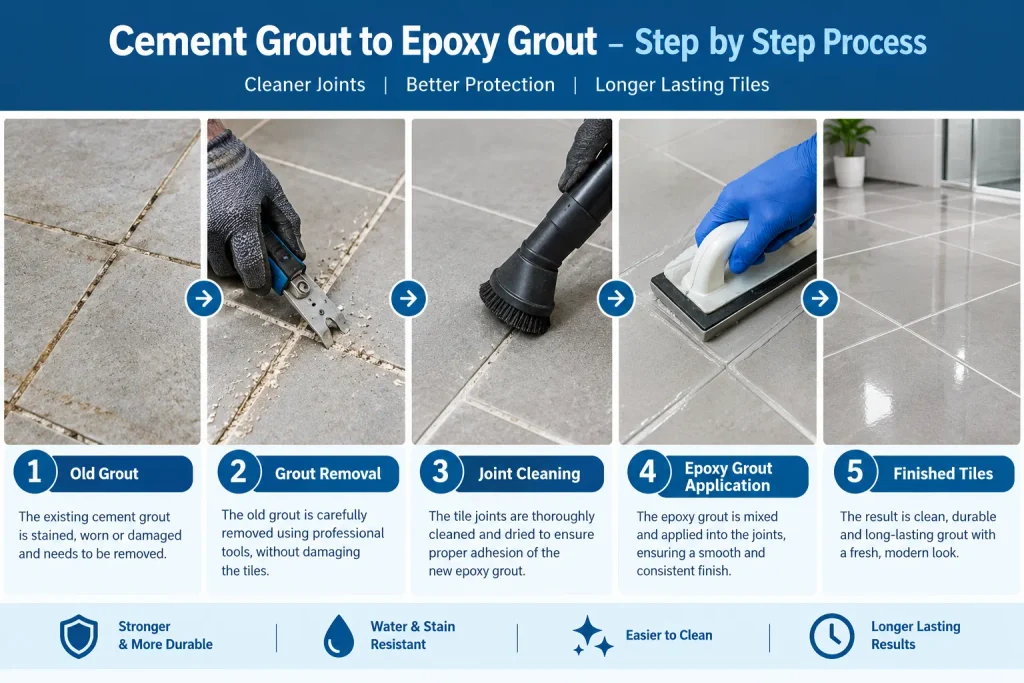
Yes, existing cement grout can often be replaced with epoxy grout, but the old grout must be properly removed first.
Simply applying epoxy grout over deteriorated cement grout is generally not the correct approach.
When Should You Replace Cement Grout?
Replacement may be considered when the existing grout is:
- Cracked
- Heavily stained
- Crumbling
- Damaged
- Difficult to clean
- Showing signs of deterioration
Removing Old Grout
The existing grout needs to be removed carefully without damaging the surrounding tiles.
Preparing Tile Joints
The joints should be clean, dry and free from loose material before new grout is installed.
Installing New Epoxy Grout
The epoxy grout is then mixed and applied according to the product requirements. Excess grout should be cleaned from the tile surface before it fully cures.
How to Choose Between Epoxy Grout and Cement Grout
There is no single grout that is suitable for every project. Consider these factors before making a decision:
1. Location
A bathroom or commercial kitchen may have different requirements from a bedroom or living room.
2. Water Exposure
Areas exposed to frequent water may benefit from a grout with low water absorption.
3. Traffic Level
High-traffic commercial floors may require a more durable grout solution.
4. Cleaning Requirements
If the area needs frequent cleaning, stain resistance and easy maintenance may be important.
5. Budget
Cement grout generally has a lower upfront cost, while epoxy grout requires a larger initial investment.
6. Tile Type
The tile material, joint size and installation conditions should be considered before selecting a grout.
7. Maintenance
Consider how much time and effort you are willing to spend on cleaning and maintaining the grout.
Epoxy Grouting Services in Singapore
Professional epoxy grouting can help improve the appearance and performance of tiled surfaces in homes and commercial properties.
A professional service may include:
- Epoxy grout installation
- Old grout removal
- Bathroom epoxy grouting
- Kitchen tile grouting
- Floor epoxy grouting
- Wall epoxy grouting
- Commercial epoxy grouting
- Grout repair and replacement
Before starting the work, the existing tile and grout condition should be inspected to determine the appropriate solution.
How Much Does Epoxy Grouting Cost in Singapore?
The cost of epoxy grouting varies from project to project. There is no single price that applies to every property.
Several factors can affect the total cost, including:
- Total area
- Number of tile joints
- Tile size
- Joint width
- Condition of existing grout
- Old grout removal requirements
- Tile condition
- Type of epoxy grout
- Labour requirements
- Accessibility of the work area
For an accurate quotation, a site assessment can help determine the actual work required.
Frequently Asked Questions
Is epoxy grout better than cement grout?
Epoxy grout offers higher resistance to water and stains and can be easier to maintain. Cement grout is generally more affordable and suitable for many standard tile applications. The right choice depends on the location and project requirements.
Is epoxy grout waterproof?
Epoxy grout has very low water absorption and provides strong resistance to moisture. However, grout should not be treated as a replacement for proper waterproofing behind tiled surfaces.
Is cement grout waterproof?
Cement grout is more porous than epoxy grout and can absorb moisture. Some cement grout products may require sealing to improve moisture and stain resistance.
Which lasts longer, epoxy grout or cement grout?
Epoxy grout can provide a long-lasting solution when properly installed and maintained. The lifespan of either grout depends on installation quality, usage, moisture exposure and maintenance.
Is epoxy grout easier to clean?
Epoxy grout is generally easier to clean because its dense surface absorbs less moisture and dirt.
Is epoxy grout more expensive than cement grout?
Yes, epoxy grout generally costs more than cement grout due to its material cost and installation requirements.
Can epoxy grout be used in bathrooms?
Yes. Epoxy grout is commonly considered for bathroom floors, walls and shower areas because of its low water absorption and resistance to staining.
Can epoxy grout replace old cement grout?
Yes, existing cement grout can often be removed and replaced with epoxy grout. Proper removal and joint preparation are important before installation.
Does epoxy grout prevent mould?
Epoxy grout’s low water absorption can help reduce moisture retention within the grout. However, mould prevention also depends on ventilation, waterproofing, cleaning and overall moisture control.
Does cement grout need sealing?
Some cement grout products and applications benefit from sealing. Always follow the grout manufacturer’s recommendations.
Which grout is better for kitchen tiles?
Epoxy grout can be a suitable choice where stain resistance and easy cleaning are priorities. Cement grout can also be suitable for many standard kitchen applications.
Can epoxy grout crack?
Epoxy grout is highly durable, but no grout is completely immune to problems. Movement in the substrate, incorrect installation or structural issues can affect grout joints.
How long does epoxy grout last?
There is no fixed lifespan for every epoxy grout installation. Proper product selection, installation, substrate condition, cleaning and maintenance all affect how long it performs.
Conclusion
Both epoxy grout and cement grout have their own advantages.
Epoxy grout is a suitable option for areas where water resistance, stain resistance, durability and easy cleaning are important. It can be particularly useful for bathrooms, kitchens, commercial areas and other demanding environments.
Cement grout is a more affordable and widely used option for many standard residential and commercial tile applications.
The right choice depends on your tile location, moisture exposure, traffic level, maintenance requirements and budget.
If you are unsure which grout is suitable for your property, a professional inspection can help you understand the condition of the existing grout and determine the appropriate solution.
Pingback: How Does Epoxy Grouting Work? Singapore Guide