
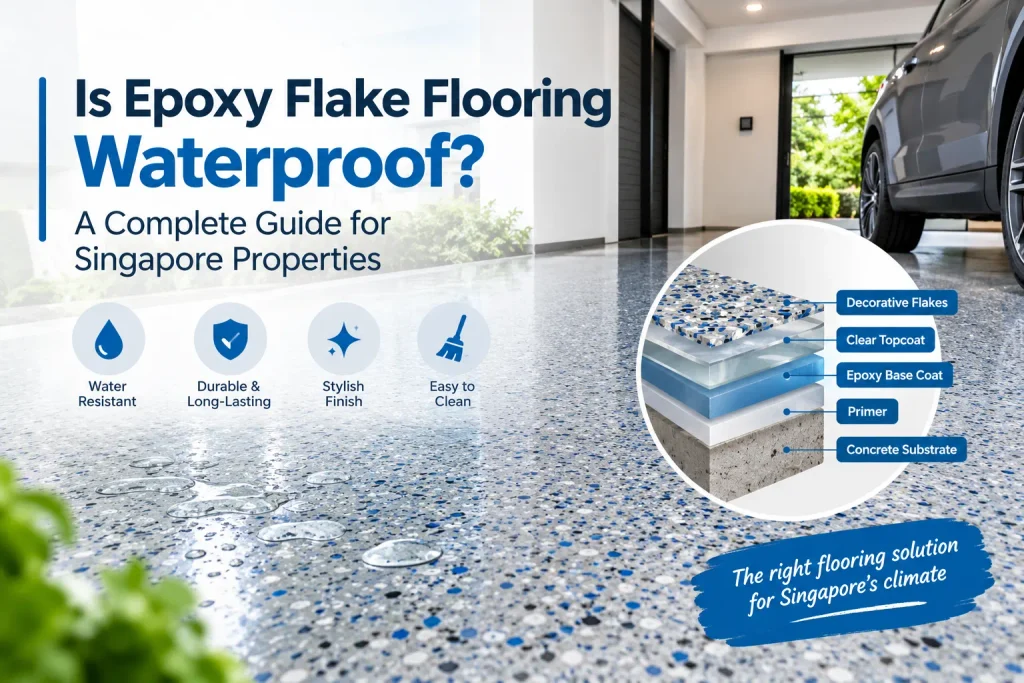
Is epoxy flake flooring waterproof? Yes, a properly installed epoxy flake flooring system with a suitable, continuous topcoat can create a water-resistant, non-porous surface that helps prevent water from penetrating the floor finish. However, it does not automatically replace a dedicated waterproofing membrane, especially in bathrooms, toilets, balconies, and other areas where water leakage could affect the structure or neighbouring units.
For homeowners, condominium owners, and commercial property managers in Singapore, understanding this distinction is important before choosing a flooring solution. Singapore’s humid climate, frequent rainfall, and everyday exposure to moisture make it essential to select the right flooring system for each application.
At MRK Renovation, epoxy flake flooring offers a decorative and practical option for suitable residential and commercial spaces. This guide explains how waterproof epoxy flake flooring works, where it is suitable, its limitations, and what to consider before installation.
Is Epoxy Flake Flooring Waterproof 100%?
Epoxy flake flooring can provide an effective barrier against surface water when the system is correctly installed and fully sealed. The epoxy coating and protective topcoat create a continuous surface that reduces water absorption and makes routine cleaning easier.
However, describing every epoxy flake floor as 100% waterproof would be misleading. The actual performance depends on the coating system, surface preparation, installation quality, and condition of the underlying concrete.
Water may still enter through:
- Unsealed edges and wall-to-floor junctions.
- Cracks in the concrete or existing floor.
- Gaps around drains and pipe penetrations.
- Damaged or worn protective topcoats.
- Moisture rising through the concrete slab from underneath.
A standard decorative floor coating is not necessarily designed to withstand water pressure from below or replace structural waterproofing.
For wet areas that require reliable leak prevention, a dedicated waterproofing system may be needed beneath the finished flooring. MRK Renovation provides epoxy waterproofing services in Singapore for property owners who need to assess their waterproofing requirements.
What Is Epoxy Flake Flooring?
Epoxy flake flooring is a decorative resin flooring system created by combining an epoxy base coat with coloured decorative flakes and a protective topcoat.
The flakes produce a textured, speckled appearance that can resemble stone or terrazzo. Depending on the selected system, the finished floor can also offer durability, easier maintenance, and improved slip resistance.
A typical epoxy flake flooring installation involves four main stages:
1. Surface Preparation
The existing concrete or approved substrate is cleaned and mechanically prepared as required. Cracks, weak areas, contamination, and existing coating problems must be addressed before installation.
2. Epoxy Base Coat Application
A compatible epoxy primer and base coat are applied to create a suitable bonding surface.
3. Decorative Flake Application
Coloured flakes are distributed across the wet base coat to achieve the selected decorative finish and texture.
4. Protective Topcoat Sealing
Excess flakes are removed where required, and a suitable clear topcoat is applied to encapsulate the flakes and create the finished surface.
The topcoat is particularly important because it helps protect the decorative layer and creates a more continuous surface. The precise installation method depends on the manufacturer’s specifications and the intended use of the floor.
How Does Epoxy Flake Flooring Resist Water?
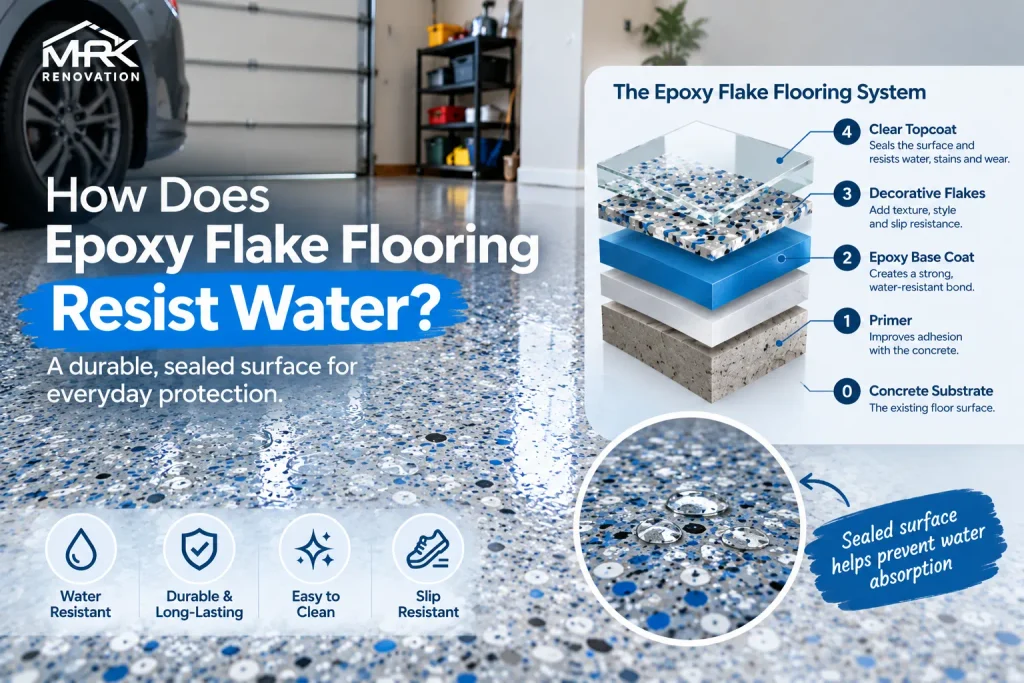
Epoxy flake flooring resists water primarily through its cured resin coating and sealed finish.
Unlike ordinary concrete, which is porous, a properly applied resin surface significantly reduces direct water absorption through the coated area. This helps protect the underlying surface from everyday spills, splashes, and routine cleaning water.
There are three important factors to consider.
Continuous coating: The base coat and topcoat must form a sufficiently continuous layer without pinholes, gaps, or exposed sections.
Proper detailing: Edges, joints, drains, and pipe penetrations require appropriate treatment because water can enter through these vulnerable points.
Moisture control beneath the coating: Excess moisture in the concrete can cause bubbling, blistering, or loss of adhesion. Existing water seepage must be investigated and addressed before applying a new coating.
Simply adding a thicker layer of epoxy will not solve every moisture problem. The entire flooring system must be suitable for the conditions of the site.
Where Is Epoxy Flake Flooring Suitable in Singapore?
Epoxy flake flooring can be suitable for various residential and commercial applications, provided the selected system matches the environment and performance requirements.
Residential Garages and Car Porches
Garages and suitable covered car porches are common applications. A properly sealed epoxy flake surface can help protect concrete from everyday dirt, vehicle-related fluids, and water brought in by rain.
For outdoor or sun-exposed areas, UV stability is also important. A compatible UV-resistant topcoat may be necessary to reduce discolouration and deterioration.
Balconies and Terraces
Epoxy flake flooring can provide a decorative finish for suitable balconies and terraces. However, these areas may be exposed to heavy rain, standing water, and direct sunlight.
Before installation, check the existing waterproofing membrane, drainage, falls, and wall junctions. A decorative coating should not be assumed to repair an existing waterproofing failure.
Living Rooms and Indoor Areas
For suitable indoor concrete floors, epoxy flake flooring offers a seamless appearance with fewer dirt-trapping joints than conventional tiled surfaces.
It can be considered for selected living areas, utility spaces, and other rooms where a durable, easy-to-clean finish is preferred.
Commercial and Industrial Spaces
Some commercial floors benefit from the durability and maintenance advantages of epoxy flake systems. However, businesses should select the coating according to foot traffic, cleaning chemicals, abrasion, and operational requirements.
Wet commercial environments may also need a specified slip-resistant finish and a separate waterproofing solution.
Bathrooms and Toilets
Bathrooms and toilets require extra care because water exposure is frequent and leakage can affect neighbouring properties.
A sealed epoxy finish may reduce surface water penetration, but it should not automatically be treated as a replacement for a properly designed waterproofing membrane beneath the finished floor.
If you are renovating a wet area, establish whether the existing waterproofing is intact and whether repairs or replacement are necessary before choosing the final floor finish.
Benefits of Epoxy Flake Flooring
When correctly specified and installed, epoxy flake flooring offers several practical benefits.
- Water resistance: A sealed surface helps resist everyday spills and surface moisture.
- Easy maintenance: The smooth, sealed finish is generally easier to clean than exposed concrete.
- Decorative appearance: Different flake colours and combinations allow property owners to customize the floor.
- Durability: Suitable systems can withstand everyday wear when matched to the expected traffic.
- Reduced dirt accumulation: A continuous finish has fewer grout lines than conventional tiled flooring.
- Optional slip-resistant texture: The flake system and topcoat can be selected to provide a suitable textured finish.
One important consideration is that water resistance does not guarantee slip resistance. A smooth epoxy finish may become slippery when wet, so the appropriate texture should be selected for the intended use.
What Are the Limitations of Epoxy Flake Flooring?
Although epoxy flake flooring has many advantages, it is not suitable for every surface or moisture condition.
It cannot automatically stop water seepage from below. Moisture moving through a concrete slab can undermine the bond between the coating and substrate.
Poor preparation can lead to coating failure. Dust, oil, loose material, and unsuitable existing finishes can prevent proper adhesion.
Cracks may reappear. Concrete movement or structural cracks can affect the finished coating unless the underlying issue is properly assessed.
Wet surfaces require suitable slip resistance. The decorative flakes alone do not guarantee a safe finish in every condition.
Outdoor exposure needs careful product selection. Standard epoxy may discolour under prolonged UV exposure, making a compatible UV-resistant topcoat important.
Understanding these limitations helps property owners avoid selecting a decorative flooring product for a waterproofing problem it was not designed to solve.
How to Choose the Right Epoxy Flake Flooring Contractor in Singapore
Choosing the right contractor is important for achieving a reliable, long-lasting finish.
Before confirming your project, consider the following questions:
- Is the existing substrate suitable? Ask how the contractor will inspect the concrete, existing tiles, or previous coating.
- Will moisture be assessed? Ask whether moisture testing is appropriate for your site and what happens if excessive moisture is detected.
- How will cracks and joints be treated? Request clarification on repairs, drains, and wall-to-floor junctions.
- What coating system will be used? Confirm the primer, base coat, decorative flakes, and protective topcoat.
- Is separate waterproofing required? This is particularly important for bathrooms, toilets, balconies, and terraces.
- What maintenance is recommended? Ask about cleaning, curing time, repairs, and any product-specific restrictions.
At MRK Renovation, property owners can explore epoxy flake flooring services and discuss the appropriate flooring system for their space. The best solution depends on the actual site conditions rather than the appearance of the finished floor alone.
Frequently Asked Questions
Is epoxy flake flooring waterproof?
A properly installed and fully sealed epoxy flake system can provide a water-resistant, non-porous surface that helps prevent water from penetrating the floor finish. However, complete waterproofing depends on the system design, installation quality, joints, edges, and underlying substrate. A separate waterproofing membrane may still be necessary.
Can epoxy flake flooring be used in bathrooms?
It can be considered for suitable bathroom applications, but the existing waterproofing system must be assessed. A decorative epoxy finish should not automatically replace the waterproofing membrane required to protect the structure and neighbouring units from leakage.
Is epoxy flake flooring suitable for balconies in Singapore?
It may be suitable when the product is designed for the exposure conditions and the existing waterproofing and drainage are adequate. Outdoor balconies may require UV-resistant materials, appropriate slip resistance, and careful treatment of edges and drainage points.
Does epoxy flake flooring prevent mold?
A properly sealed surface reduces water absorption and makes routine cleaning easier, which can help limit moisture-related problems on the floor surface. However, it does not eliminate mold caused by persistent dampness, leaks, condensation, or moisture trapped beneath the coating.
Is epoxy flake flooring slippery when wet?
It can be. Slip resistance depends on the surface texture, topcoat, contamination, and amount of water present. A suitable anti-slip finish should be specified for garages, balconies, wet areas, and other locations where people may walk on damp flooring.
How long does epoxy flake flooring last?
Its service life depends on the coating system, substrate preparation, traffic, environmental exposure, maintenance, and installation quality. Ask the contractor for product-specific guidance and warranty terms rather than relying on a universal lifespan estimate.
Can epoxy flake flooring be applied over existing tiles?
In some situations, it may be possible after assessing the tiles, grout, adhesion, surface preparation requirements, and compatibility of the proposed system. Loose or hollow tiles, moisture problems, and unstable substrates must be addressed first. Not every tiled floor is suitable for an overlay.
How do I get an epoxy flake flooring quotation in Singapore?
Start by identifying the property type, approximate floor area, current flooring condition, and whether the area experiences frequent water exposure. Contact MRK Renovation to discuss your requirements and arrange an assessment of the appropriate flooring solution.
Conclusion: Is Epoxy Flake Flooring the Right Choice?
Epoxy flake flooring can be an attractive, durable, and water-resistant flooring option for suitable homes and commercial properties in Singapore. Its performance depends on proper surface preparation, a compatible coating system, effective sealing, and attention to vulnerable areas such as drains and floor edges.
The key is to distinguish between a water-resistant decorative finish and a complete waterproofing system. If your project involves a bathroom, toilet, balcony, or existing water leakage, assess the underlying waterproofing before installing a new floor coating.
Planning an epoxy flake flooring project in Singapore? Contact MRK Renovation through mrkrenovation.com to discuss your property, flooring requirements, and suitable installation options.